
· by Michael Blair, Nashville's Landscapers
The first worry we hear about a backyard pond is mosquitoes, and it is a reasonable one in Middle Tennessee, where the season runs long and summers stay warm and humid. A pond can raise mosquitoes. A well-built one rarely does, because the same features that keep the water clear also make it a poor place for larvae to survive.
Here is what makes a pond attractive to mosquitoes, what keeps one clean, and when a pondless waterfall is the better design for a yard.
Does a backyard pond attract mosquitoes?
A backyard pond attracts mosquitoes when its water is still, when it holds no fish, or when plants cover its surface. Purdue University’s guide to managing ponds to minimize mosquitoes says small, shallow ponds become a problem when they lack fish or water movement, or when aquatic plants cover their edges or the whole surface. The same guide notes that mosquito larvae feed on organic debris in the water, so leaves left to rot in a pond help them along.
Mosquitoes do not need much water to breed. University of Illinois Extension’s mosquito page says a female will lay eggs in any stagnant water, that larvae can develop in as little as a cup, and that they take five to seven days to become adults. A forgotten bucket, a clogged gutter or a saucer under a planter can raise more mosquitoes than a working pond.
How does moving water keep mosquitoes out of a pond?
Moving water keeps mosquitoes out because larvae have trouble surviving on a disturbed surface. The Purdue guide counts wave action and water movement among the main things that cut larval survival. For a small pond that has gone stagnant, it recommends restoring movement with a fountain, a waterfall or an aerator.
The pump has to keep running for this to work. Illinois Extension’s page on pumps and fountains says an agitated surface makes the water less attractive to mosquitoes without keeping them out entirely. It also warns that a pump set on a timer to shut off at night leaves the water still while mosquitoes can lay eggs. So we size the pump and the electrical circuit to run continuously, and we place the waterfall so its ripples reach across the whole pond rather than one corner.
Which fish eat mosquito larvae in a garden pond?
Minnows and other fish that feed at the surface eat mosquito larvae. Koi do not, even though they are the fish most people picture. Illinois Extension recommends stocking ornamental ponds with minnows or other surface feeders and notes that koi are vegetarians and will not help. The Purdue guide also names top-feeding minnows as effective control in small ponds.
Purdue describes the mosquito fish, Gambusia affinis, as the most effective fish for ponds that are not connected to natural waterways. It also says not to use mosquito fish in a pond that does connect to a creek or stream. Where fish are not an option, Illinois Extension says ornamental ponds can be treated with Bti, which comes as donuts, briquettes or granules and controls larvae for a month or more.
Purdue adds that shade in the afternoon helps keep fish alive through hot summers, and that grass clippings and fertilizer should be kept out of the water. That fits the planting around the edge of every pond we build.
Pond or pondless: which suits a Nashville yard?
A pondless waterfall is the better choice when you want the sound of water and have no interest in keeping fish or water plants. In a pondless design the water flows over the stones and drains into a reservoir buried under gravel, where the pump sits, so there is no open pool for a mosquito to land on.
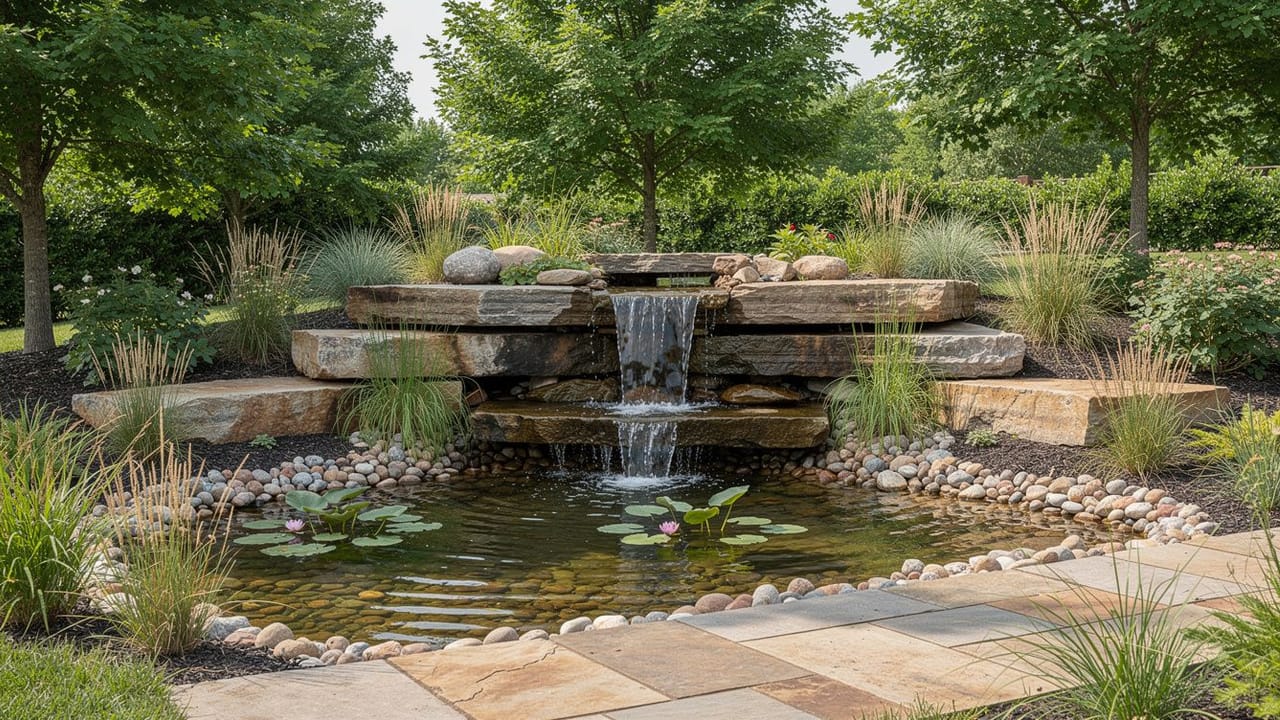
A pond fits when you want fish, water lilies and a surface that reflects the sky. It works when it is built as a small system in balance, with moving water, the right fish and plants kept to part of the surface. November is when fallen leaves end up in both kinds of feature, so this is the time to clear them out.
Both designs are on our water features page, and either one starts on the drawing in a landscape design. If you are in Franklin or nearby and weighing one against the other, ask us for an estimate and we will walk your yard with you.
Sources
- Purdue University, Management of Ponds, Wetlands, and Other Water Reservoirs to Minimize Mosquitoes (WQ-41-W) — Small ponds are prone to mosquitoes without fish, movement or with plant-covered surfaces; larvae feed on organic debris; wave action cuts larval survival; restore movement with fountain, waterfall or aerator; top-feeding minnows; mosquito fish only in ponds not connected to waterways; afternoon shade; keep clippings and fertilizer out
- University of Illinois Extension, Mosquitos — Eggs laid in any stagnant water; larvae develop in as little as a cup of water in 5–7 days; stock ornamental ponds with minnows or surface feeders, koi will not help; Bti treatment controls larvae a month or more
- University of Illinois Extension, Pumps and Fountains — An agitated surface reduces the attraction to mosquitoes but does not prevent them; a pump timed off at night lets mosquitoes lay eggs
FAQ
Do Water Features Breed Mosquitoes? Pond or Pondless — questions
Do koi eat mosquito larvae in a pond?
Not in a way that helps. Illinois Extension notes that koi are vegetarians and will not control mosquitoes. For a garden pond, it recommends minnows or other surface-feeding fish, and Purdue names top-feeding minnows as effective in small ponds. Koi can share a pond with minnows, but the minnows do the work on the larvae.
Should a pond pump run all night?
Yes, if mosquitoes are a concern. Illinois Extension warns that a pump on a timer that turns it off at night leaves the water still while mosquitoes can lay eggs. A moving surface makes the water less attractive to them. We size the pump and its circuit to run continuously.
Does a pondless waterfall attract mosquitoes?
Much less than a pond does. In a pondless waterfall the water runs over stone and drains into a reservoir buried under gravel, so there is no open, still surface for a mosquito to lay eggs on. When the pump is running, the stream itself is moving water, which larvae have trouble surviving.
How fast can mosquitoes breed in standing water?
Fast. University of Illinois Extension says mosquito larvae take five to seven days to become adults, and that they can develop in as little as a cup of water. Emptying or changing any still water at least once a week, such as in birdbaths and plant saucers, breaks that cycle.
Can you treat a garden pond for mosquito larvae without fish?
Yes. Illinois Extension says ornamental ponds can be treated with Bti, which is sold as donuts, briquettes or granules and controls larvae for a month or more. Restoring water movement with a fountain, waterfall or aerator, as Purdue recommends for stagnant ponds, is the longer-lasting fix.