
· by Michael Blair, Nashville's Landscapers
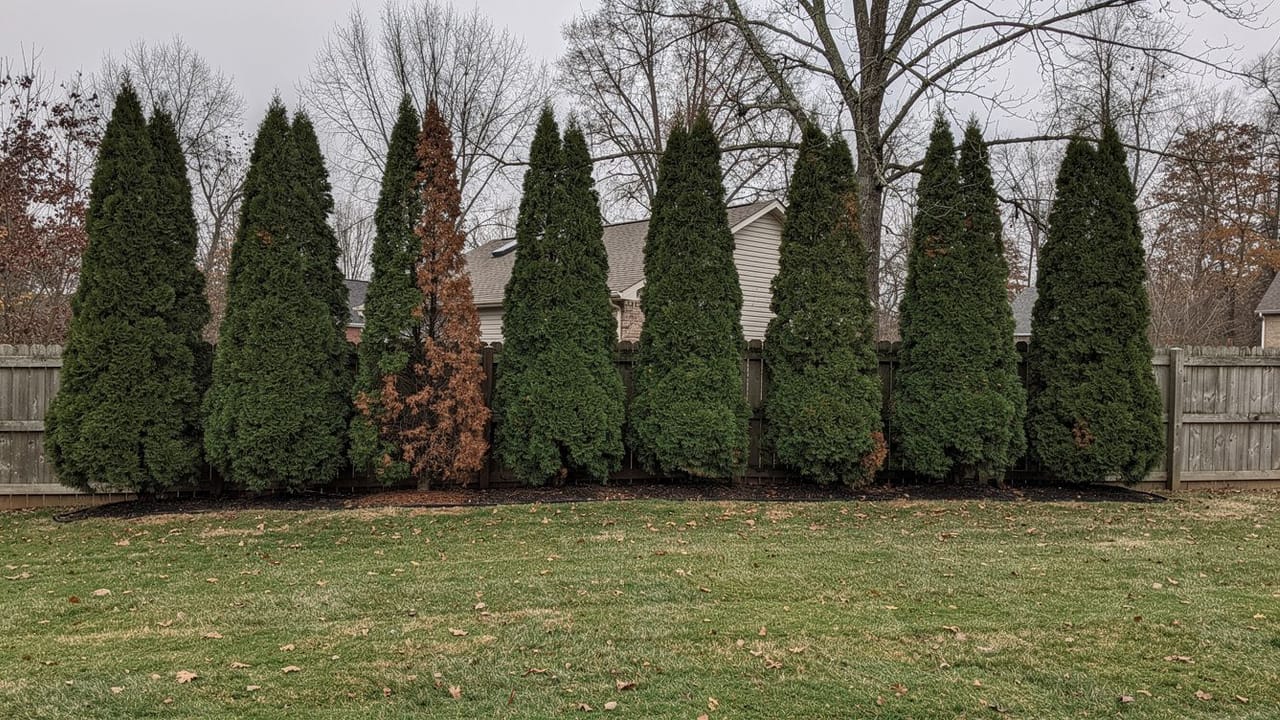
Late November is when a Nashville backyard loses its privacy. The maples and oaks along the fence drop their leaves, the neighbor’s deck is suddenly in full view, and the row of Leyland cypress that was supposed to fix that has a brown streak running through it. Leyland is the fastest screen most people know, and a browning one raises two questions: can it be saved, and what should go in instead? Here are the answers, while the fall planting window is still open.
Why are Leyland cypress trees turning brown?
Most browning Leylands have a canker disease that took hold while the tree was under stress. UGA Extension’s bulletin on diseases of Leyland cypress in the landscape names Seiridium canker as the most destructive, showing first as yellow or brown foliage on one or more branches, with thin, sunken cankers and resin running down the bark. Botryosphaeria canker looks much the same from the yard but produces little or no resin. The University of Maryland Extension page on both cankers adds that resin alone does not prove Seiridium, since healthy Leylands can bleed resin too.
Stress is what lets them in. UGA says Seiridium cankers can spread as much as three times as fast on a tree short of water as on one that is well watered, and that Leylands, with their shallow roots, often go in too tightly spaced, on ground that drains poorly, and that opens them to Phytophthora root rot. A Middle Tennessee yard can supply both kinds of stress: dry spells in late summer, and clay that holds water through the winter. Spores travel in splashing rain and irrigation water and on pruning tools, so the disease can move down a tight row.
Can a Leyland cypress with canker be saved?
Sometimes, if the cankers are on side branches and the trunk is clean. UGA recommends cutting out cankered twigs and branches, disinfecting pruning tools in rubbing alcohol or a solution of one part bleach to nine parts water, and removing trees that are badly damaged or cankered in the main trunk. Maryland says to make each cut at least several inches below any visible canker or dead wood.
Spraying will not do it. UGA says fungicides provide no control once infection has happened and that no Leyland cultivar is known to resist Seiridium, and Maryland says fungicides are not effective against either disease and warns against overfeeding a stressed tree. The treatment that counts is water: UGA calls irrigation during drought the best defense, with a thorough soaking at the base every 7 to 14 days in hot, dry weather, and a layer of mulch spread several feet beyond the lowest limbs to hold moisture.
What should you plant instead of Leyland cypress?
Plant a mix of evergreens rather than another single row of one plant. NC State Extension’s plant toolbox entry for Green Giant arborvitae calls it a good alternative to Leyland cypress: it resists most diseases, insects, periodic drought and deer, tolerates a wide range of soils, and can grow 3 to 4 feet a year to 40 to 60 feet tall and 12 to 18 feet wide. It came to the United States in 1967 through the U.S. National Arboretum. NC State also warns that, like Leyland, it gets very large quickly, and that root rot can occur in poorly drained soil.
We pair it with a broadleaf evergreen and a native. NC State’s entry for Nellie R. Stevens holly puts it at 15 to 30 feet tall and 8 to 25 feet wide, tolerant of heavy clay, drought and heat but not of wet sites, and it sets some berries even without a male holly nearby. Its entry for eastern redcedar describes a native with the best drought resistance of any conifer in the eastern United States, 30 to 40 feet tall and intolerant of soil that stays wet. A screen of different plants does not fail all at once when one of them has a bad year.
Spacing a screen for the size it will reach
Crowding is one of the stresses UGA blames for Leyland failures, so a new screen is spaced for mature width rather than for how quickly the gaps close. NC State gives eastern redcedar 12 to 24 feet between plants, and Green Giant’s 12-to-18-foot spread calls for room on the same scale. Staggering the plants in two rows lets each one keep its space while the screen fills in sooner. On Middle Tennessee clay, the wet-soil warnings on all three plants matter as much as the spacing, so we look at where water sits before we set the line.
Now is a good time to plant one. Our post on the right month to plant in Middle Tennessee covers the fall window, and our post on how far from the house to plant covers setbacks. Screens are part of our planting and beds work, and a long one is worth drawing as part of a landscape design. If a Leyland row in Franklin or anywhere nearby has started to brown, ask us for an estimate.
Sources
- University of Georgia Extension, Bulletin 1229: Diseases of Leyland Cypress in the Landscape — Seiridium and Botryosphaeria canker symptoms; cankers enlarge up to three times faster under drought; planted too close and in poorly drained soil; sanitation; fungicides no control once infected; irrigation the best defense
- University of Maryland Extension, Seiridium and Botryosphaeria Canker of Leyland Cypress — Resin flow not diagnostic alone; prune several inches below cankers; avoid over-fertilization; fungicides not effective
- NC State Extension Gardener Plant Toolbox, Thuja Green Giant — Alternative to Leyland cypress; disease, insect, drought and deer resistance; 3 to 4 feet a year; 40 to 60 feet by 12 to 18 feet; root rot in poorly drained soil
- NC State Extension Gardener Plant Toolbox, Ilex Nellie R. Stevens — Size; tolerates heavy clay, drought and heat; avoid wet sites; sets some fruit without a male pollinizer
- NC State Extension Gardener Plant Toolbox, Juniperus virginiana — Native eastern redcedar; best drought resistance of eastern conifers; intolerant of continuously wet soil; plant 12 to 24 feet apart
FAQ
Leyland Cypress Turning Brown? Better Privacy Screens — questions
How fast does a Green Giant arborvitae grow?
Quickly. NC State Extension says Green Giant can grow 3 to 4 feet a year in good conditions and reach 40 to 60 feet tall and 12 to 18 feet wide. That speed is why it replaces Leyland cypress, and it is also why it needs the same room: planted too close, it outgrows the space.
Do deer eat Green Giant arborvitae?
NC State Extension lists deer among the things Green Giant resists, along with most diseases, insects and periodic drought. Resistant is not the same as deer-proof, though, so on a lot that backs onto woods we would rather plant a mixed screen than a single row of one plant, which spreads the risk if deer take a liking to it.
Does Nellie Stevens holly need a male holly to have berries?
Not entirely. NC State Extension explains that hollies have separate male and female plants and that Nellie R. Stevens is a female that sets some fruit without a male pollinizer. It names Chinese holly and Edward J. Stevens as good male pollinizers, so planting one that blooms at the same time nearby helps the berry set.
Can Leyland cypress disease spread to other plants?
Botryosphaeria can. UGA Extension says the fungus behind Bot canker also attacks azaleas, rhododendrons, flowering dogwoods and redbuds, especially plants stressed by freezing, drought or heat. Both Bot and Seiridium spores move in splashing rain and irrigation water and on pruning tools, so disinfect tools between cuts and remove cankered wood from the yard.
Should I fertilize a struggling Leyland cypress?
No. University of Maryland Extension advises against over-fertilizing Leylands with canker and says fungicides are not effective either. What a stressed tree needs is water and mulch: UGA calls irrigation during drought the best defense against Seiridium canker and recommends mulching several feet beyond the lowest branches to hold moisture in the soil.