
· by Michael Blair, Nashville's Landscapers
A pallet of sod looks like a finished lawn, which is why it is easy to treat laying it as the whole job. It is closer to transplanting a few thousand small plants with very short roots, and most of them either take hold or die in the first month. Homeowners in Brentwood and the towns around it usually ask us two things about sod and grading work: when it can go down, and what to do with it once it is there. Both answers come from the University of Tennessee’s turfgrass publications, and they are the schedule our crews work to on fescue lawns.
What time of year can fescue sod go down in Tennessee?
Tall fescue sod can go down in most of the year here; July and August are the months to avoid. UT Extension’s When to Plant Turfgrasses (W160-F) says tall fescue and Kentucky bluegrass sod is most often installed from January through June and from September through December, and that many growers do not like to market cool-season sod in midsummer, when the plants are prone to heat stress and disease.
That is a narrower question than when to seed. The same publication puts late August to mid-October as the ideal time to seed cool-season grasses in Tennessee, and our post on the right month to plant in Middle Tennessee covers seed, shrubs and bulbs. Sod gets past the seedling stage, so it has a wider calendar. Bermuda and zoysia sod are different again: W160-F says warm-season sod can go in all year if the bed is not frozen, but dormant sod may need weeks or months before it can take traffic.
What does the bed need before the first roll goes down?
The bed should be fertile and moist, not saturated. That is the wording in UT Extension’s Sodding and Plugging (W160-C), and on heavy Middle Tennessee clay the second half of it matters. A bed watered into mud the day before gives the new roots nowhere to breathe, and a dry, crusted one pulls the moisture straight out of the thin soil layer on the back of each slab. North Carolina’s guide, NC State Extension’s Carolina Lawns, sets the same line for the soil, moist but not overly wet, and says watering it several days before the sod is delivered is often enough.
On newer lots in Brentwood and Franklin, the ground under the lawn is often graded subsoil that was packed down during construction, so we look at what the sod will sit on before anything is ordered. If water stands there or runs toward the house, that gets fixed first, which is the same reasoning as where the water goes in a Nashville yard. Sod laid over a low spot only covers the problem for a season.
Timing the delivery is part of the bed work. W160-C says actively growing sod should be installed within 24 to 48 hours of harvest, and that the center of a stacked pallet can climb past 120 degrees Fahrenheit very quickly. A pallet of slab sod holds about 50 square yards and can weigh 2,000 pounds or more, so we plan where it will be set down and how much can be laid in a day before it arrives.
How the slabs are set, seamed and rolled
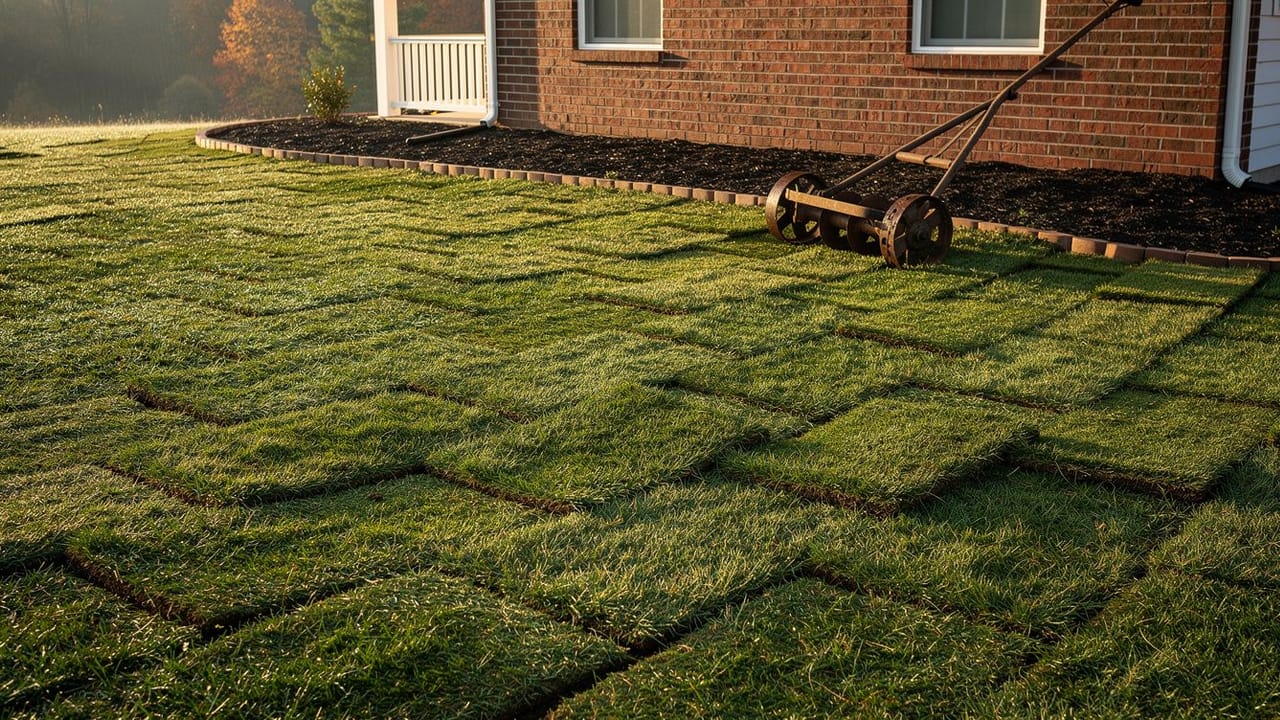
W160-C asks for slabs or rolls that fit together tightly without being stretched or overlapped, staggered much like bricks in a wall. Stretched sod shrinks back and opens gaps; overlapped edges sit high, dry out and brown. Staggering the ends keeps the seams from lining up into one long channel that dries first.
Where the sod meets a bed, a walk or a driveway, the edge seams get soil worked into them right after laying so the exposed roots do not dry out. The same publication warns that weeds such as crabgrass and goosegrass can come up quickly in open seams, another reason to keep them closed. Then the whole area is rolled or tamped, which W160-C says removes air pockets and puts the sod in contact with the soil. Roots cannot cross an air gap, so a slab that is not pressed down can sit on top of the bed for weeks without rooting.
- Slabs pushed tight, never stretched or overlapped
- Ends staggered like brick
- Soil worked into the edge seams
- Rolled or tamped, then watered within hours
How much water does new sod need, and when is the first mow?
New sod needs a little water every day at first, then deeper and less often. W160-C says to irrigate within a few hours of planting, then lightly every day for several weeks: 1/8 to 1/4 inch, roughly 75 to 150 gallons per 1,000 square feet, with early morning between 5:00 and 10:00 a.m. preferred. As the roots grow into the soil below, the schedule shifts to about 1/2 inch, around 300 gallons per 1,000 square feet, every two to three days.
An established fescue lawn uses far more than that in hot weather. UT’s Irrigation (W161-F) works through a tall fescue example that comes to about one and a half inches a week to replace what the grass loses. That is the direction a new lawn is headed, not where it starts.
The first mow comes when the fescue averages 3 inches tall, cut to 2 inches, and W160-C says never to remove more than one-third of the leaf at once. About three to four weeks after sodding, it calls for 1/2 pound of nitrogen per 1,000 square feet, watered in with at least 1/2 inch, unless heat or cold is stressing the turf. It also names Pythium blight and large brown patch as diseases that can badly injure new turf, and white grubs as the reason a lawn can be rolled back like a carpet.
If you are planning new sod, our crews handle the grading, the bed and the laying on our grading and sod page, including lawn and landscape work in Brentwood. The way to start is a visit to look at the ground, which you can ask for on our contact page.
Sources
- University of Tennessee Extension, W160-C Turfgrass Establishment: Sodding and Plugging — Moist, fertile bed; install within 24 to 48 hours of harvest; pallet heat and size; tight staggered seams and seam soil; rolling; watering schedule; first mow at 2 inches when 3 inches tall; one-third rule; nitrogen at three to four weeks; Pythium blight, large brown patch and white grubs
- University of Tennessee Extension, W160-F Turfgrass Establishment: When to Plant Turfgrasses — Tall fescue sod months, July and August avoided by growers, cool-season seeding window, warm-season sod and dormancy
- NC State Extension, Carolina Lawns: A Guide to Maintaining Quality Turf in the Landscape — North Carolina guidance: soil moist but not overly wet before laying sod, often enough to irrigate several days before delivery
- University of Tennessee Extension, W161-F Turfgrass Maintenance: Irrigation — Tall fescue example of about one and a half inches of water a week
FAQ
Laying Fescue Sod: The Bed, the Water and the First Mow — questions
When can you mow new sod for the first time?
Wait until the fescue averages about 3 inches tall, then cut it to 2 inches. UT Extension says never to take off more than one-third of the leaf at once. On a freshly laid fescue lawn kept watered, that first cut usually comes after the light daily watering has moved toward deeper, less frequent soakings.
How often should you water new sod?
Once within a few hours of laying, then lightly every day for several weeks, about 1/8 to 1/4 inch in the early morning. As the roots grow into the soil, UT Extension moves to about 1/2 inch every two to three days. A bed kept soggy is as hard on new sod as one left dry.
Should you roll sod after laying it?
Yes. Rolling or tamping the new sod presses out the air pockets and puts the slabs in contact with the soil underneath, which UT Extension calls for after installation. Roots cannot cross an air gap, so sod that is never pressed down can sit on the bed for weeks without rooting into it.
How long can sod sit on the pallet before it is installed?
Not long. UT Extension says actively growing sod should be installed within 24 to 48 hours of harvest, because the center of a stacked pallet can heat past 120 degrees Fahrenheit very quickly. Shaded slabs in that heat often die, so we schedule delivery for the day the bed is ready.
What is the best time of year to lay fescue sod in Tennessee?
UT Extension says tall fescue sod is most often installed from January through June and from September through December. Many growers will not sell cool-season sod in July and August, when it is prone to heat stress and disease. Those are the same summer months when established fescue around Nashville struggles most.
Why is my new sod turning brown?
Usually water or heat. Seams that dried out, slabs never pressed onto the soil, or sod that sat too long on a hot pallet all brown first. In new turf, UT Extension also names Pythium blight and large brown patch, and white grubs that leave sod loose enough to roll back like a carpet.