
· by Michael Blair, Nashville's Landscapers
Search for paver installation and most of what comes back is about the stone: the color, the pattern, the price per square foot. The pavers are the part that rarely goes wrong. When a patio spreads at the edges, grows weeds in every seam, or holds a sheet of water after a storm, the cause is almost always one of four things that sit around and between the units: the restraint along the border, the sand bed they are set in, the pitch of the surface, and the sand in the joints. This is how our crews handle each of those on a paver patio or walkway, checked against the installation guides two paver manufacturers publish.
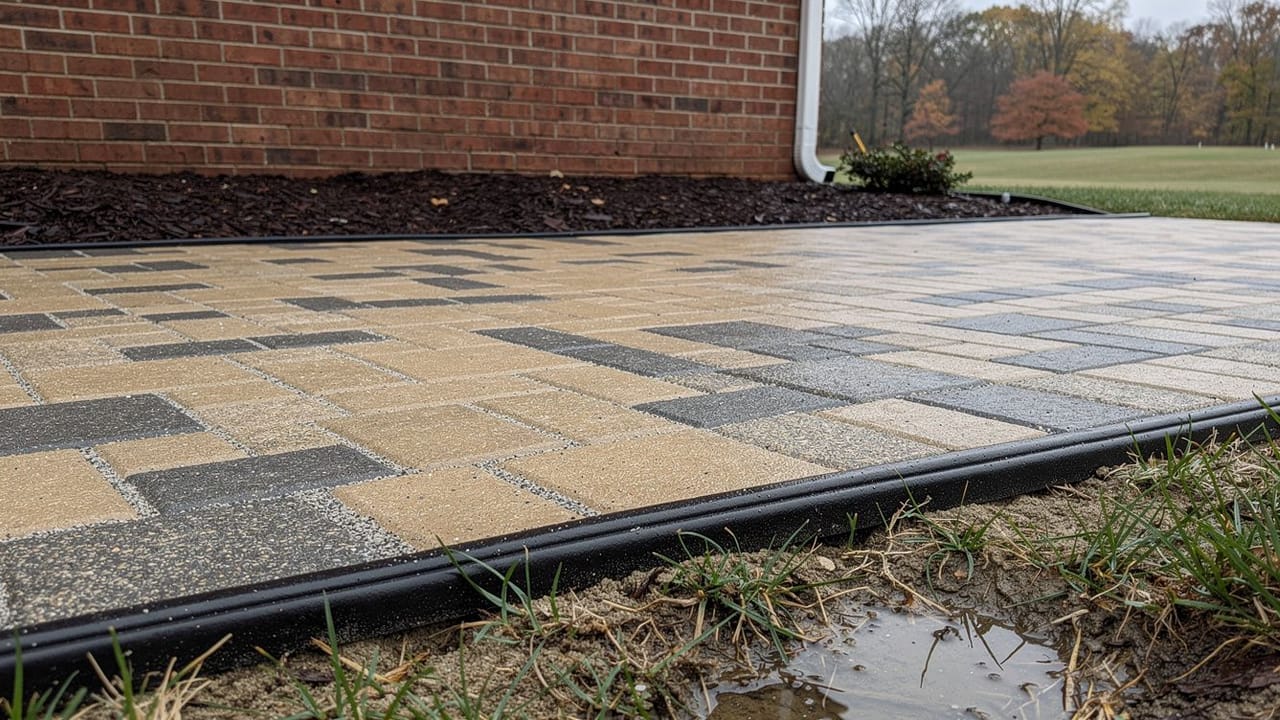
The border has to be held, and held at the right height
An interlocking paver surface works because each unit is wedged against its neighbors. That only holds if the outside row cannot move. Nothing about a paver keeps it from walking outward under foot traffic, a grill being dragged, or a car tire on a driveway apron, so the perimeter needs something solid against it. Belgard’s Technical Resource Guide lists the usual choices: spiked plastic, steel or aluminum edging, or a poured concrete curb set on compacted aggregate.
Two details in that guide get skipped often. The restraint goes on the compacted base, not on loose soil or on top of the sand bed, and it has to present at least one inch of vertical face against the side of the paver. An edge that sits too low lets the outer pavers ride up over it; one set on soft ground leans out the first wet season. Where the patio meets a planting bed, we keep the mulch and soil below the restraint so the edge stays visible and does its job instead of being buried.
A thin sand bed and a pitch you can barely see
Between the compacted base and the pavers sits the bedding layer, and the Belgard guide puts it at a nominal one inch. That number is a ceiling as much as a target. The sand bed exists to let each paver settle evenly into place when the surface is compacted, not to make up for a base that was left uneven. A thick bed of sand used to fill dips in the base is soft, and it is where ruts and low spots show up a year later. Belgard also calls for pavers at least 2 3/8 inches thick for walking surfaces and driveways.
The same guide sets the finished surface at a minimum 2 percent slope for drainage, and notes that pavers pitched at 2 percent drain quickly. Two percent works out to roughly a quarter inch of fall for every foot, which on a 12-foot patio is about three inches from the house side to the far edge. It is hard to see standing on it, and it should be. What matters is which way it falls: always away from the foundation, and toward somewhere the water can go. On a lot where the yard already pitches back toward the house, that question gets answered before any paver is set, which is the same thinking behind where the water goes in a Nashville yard.
The ground under all of this varies more than people expect. The University of Tennessee’s Welcome Home series on Tennessee climate and soils points out that soil profiles can differ from one county to the next, and that construction, added fill and heavy traffic leave compacted soil behind. On a newer lot that can mean fill and packed clay under the topsoil, so we dig to find out what the patio will be sitting on rather than assuming.
Joint sand: what it does and why it washes out
The sand between pavers is not decoration. It locks the units together so a load on one is shared with the ones around it. Belgard’s guide has dry joint sand swept in, the surface run with a plate compactor, and the sand swept in again because it settles into the joints during compaction. The joints should end up full, with the fill no more than half an inch down from the top of the paver.
Plain sand does not always stay there. The Belgard maintenance section names the two usual causes of joint sand loss: water running across the surface and scouring it out, and sloped surfaces. Middle Tennessee gets both, with heavy downpours in spring and summer and plenty of patios and walks built on rolling ground. Belgard recommends polymeric jointing sand, which contains a binder that sets the sand in place and helps keep out weeds and insects. Unilock’s polymeric sand guide makes the same comparison, saying plain jointing sand may need more frequent top-ups on wider joints and steeper paver surfaces.
Polymeric sand only works if it is put in under the right conditions. Unilock’s guide calls for a completely dry surface, clear weather and a stable base before it goes down. The joints are filled to about an eighth of an inch below the rounded or beveled top edge of the paver, every bit of excess is swept or blown off the faces before the plate goes over it, and the water that activates the binder is misted on in passes rather than flooded across. It then needs its cure time before anyone walks or drives on it. Residue left on the paver face hardens there, which is why we do not rush that last sweep.
- Pavers set, compacted, and joints swept full
- Excess cleaned off the faces completely
- Joints about 1/8 inch below the bevel
- Light misting in passes, then cure time before use
After the first year: refilling, sealing and the white haze
A finished patio still needs a look now and then. Belgard’s guide gives a clear trigger for the joints: once the sand has dropped more than half an inch, measured from the bottom of the chamfer, the joint fill should be replaced. A look along the low edge and any spot where a downspout empties onto the surface is enough to tell. Left too long, the units start to rock, and a rocking paver chips at the edges.
New concrete pavers often show a white, chalky film in the first months. Belgard explains that this is efflorescence, a calcium carbonate deposit that comes up through the concrete, and that it does not affect structural performance. It is also the reason the guide says to wait until the pavers have been in service for one year before applying a sealer, so the efflorescence has time to come out instead of being sealed under the surface.
If you are getting quotes, the questions that separate one installer from another follow from all of this: what holds the edges and what it sits on, how thick the sand bed will be, which way the surface pitches and where the water goes from there, and what goes in the joints. You can see how we approach patios, walks and steps on our hardscaping page and the base work behind them on our patios and walkways page. We build across Davidson County and the counties around it, including paver work in Brentwood, and the next step for your yard is a visit, which you can ask for on our contact page.
Sources
- Belgard, Technical Resource Guide (Paver Installation Recommendations and Paver Maintenance) — Edge restraint types and placement, one-inch bedding layer, 2 percent minimum slope, minimum paver thickness, joint sanding and compaction, polymeric sand recommendation, joint refill trigger, efflorescence and sealing after one year
- Unilock, Polymeric Sand Guide — Dry surface and clear weather before application, fill to about 1/8 inch below the bevel, clean faces before compaction, mist in passes, cure before traffic, plain sand needs more top-ups
- University of Tennessee Institute of Agriculture, UT Hort, Welcome Home Week 1: TN Climate and Soils — Soil profiles differ from county to county; construction, fill and traffic compact soil