
· by Michael Blair, Nashville's Landscapers
Landscape lighting is one of the few improvements that changes a house every single evening, and one of the most reliably disappointing when it is done cheaply. The failures are predictable, and almost none of them are the fixtures.
Where these systems actually fail
The connections. A low-voltage system is a cable run through wet ground with a splice at every fixture, and the twist-on connectors packed with most kits are not rated for burial. Water wicks in, the copper corrodes green, and lights start dropping off the run one at a time.
What lasts is a gel-filled or heat-shrink waterproof connector at every joint, or better, a silicone-filled direct burial connector. It is a small part of the material cost and the single biggest predictor of whether the system still works in five years.
Voltage drop over a long run
A twelve-volt system loses voltage along the cable, and the fixtures at the far end of a long run go dim and yellow while the near ones are bright. On a large Nashville lot with beds along a driveway, this is the second most common complaint.
The answers are heavier cable, splitting the load across several runs from the transformer rather than one long daisy chain, or using the higher voltage taps most transformers provide. LED fixtures tolerate the drop far better than the old halogens did, which is one reason retrofits often look better than the original.
Laying it out so it does not look like an airport
The common mistake is a line of identical fixtures evenly spaced along a path or a foundation. It reads as runway lighting and it flattens the house rather than shaping it. Light should come from a few directions and leave dark between.
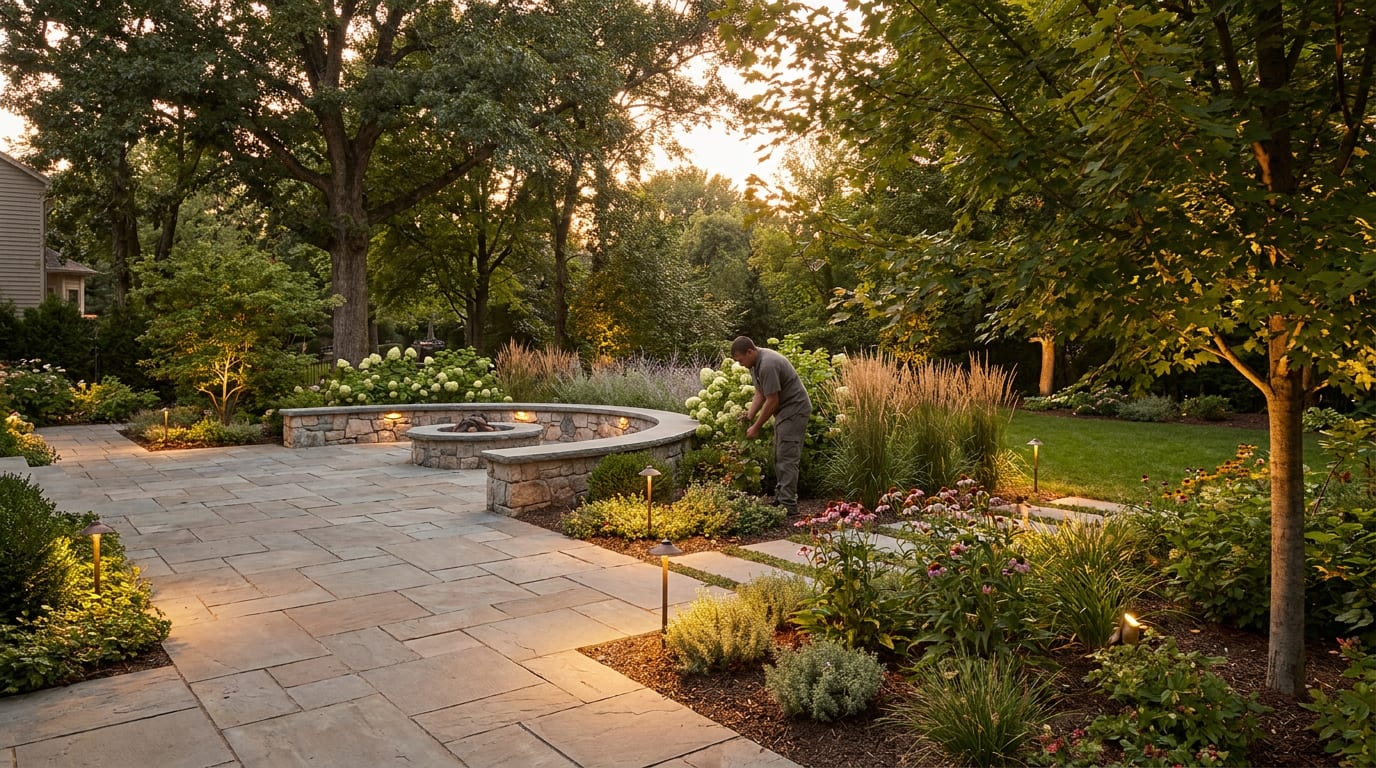
Uplight the trees with real structure and the corners of the house. Wash the texture on a brick or stone wall by placing the fixture close and aiming up the face. Path lights are for actual navigation hazards such as steps and turns, not for lining a walk at even intervals.
- Uplight mature trees and architectural corners
- Graze stone and brick from close range to show texture
- Path lights only where footing genuinely changes
- Leave dark gaps between lit areas
- Aim fixtures away from windows and the street
What Middle Tennessee does to the hardware
Humidity gets into anything not properly sealed, and freeze-thaw cycles work fixtures loose from the ground over a couple of winters. Brass and copper fixtures weather to a patina and keep working; painted aluminum and plastic here tend to chalk, crack and go brittle in the sun.
Mulch is the other quiet problem. Beds get topped up every spring and the fixtures gradually sink until they are lighting the inside of the mulch layer. Lifting and resetting fixtures is a five-minute annual job that most systems never get.